Artificial intelligence… will it take over art?
An AI-generated image won a fine arts prize. The argument is as old as photography.

Just a few weeks ago, we took on the task of offering some notions about the metaverse: its projections, its promises and its possible deceptions. It should be said, however, that we were not trying to dent any structure with that —we are sensible and realistic—, but it seemed fitting to us to raise the flag of critical judgment and offer alternative paths toward new horizons of debate.
Technology advances with overwhelming speed. Every few months a new development bursts into the environment and both users and markets are left in a state of processing. The frankly exponential evolution of the technology sector outstrips our capacity to react and, moved by the fear of astonishment, more often than not we rush to reject elements that, being the technical innovations they are, amount to invaluable tools. But we should not forget that our species, faced with the sudden roar of the unknown, has many times fallen into regrettable mistakes.
The new journalistic milestone that has been discussed on social media for the past few days was brought about by the annual Fine Arts contest of the Colorado State Fair. It is a fine arts contest covering various disciplines. Well then, the paradigmatic case was that of Jason M. Allen, entered in the «Digital Arts/Digitally-Manipulated Photography» category, who presented the work Théâtre D’opéra Spatial, taking the blue ribbon for emerging artists, along with its respective prize of 300 USD, and becoming one of the first digital creators to win a prize thanks to an AI-generated image.
The event set off no small amount of controversy across all social media, where the most varied personalities expressed themselves —both for and against. But, before going on, we must focus on the first question:
How is an AI-generated image obtained?
This kind of element is provided by different developers; the most outstanding are: DALL-E 2, Stable Diffusion and Midjourney (it is precisely the last of these sites that Allen used to create his work). These platforms work through a process of deep learning, algorithms designed for machine learning; the user enters words and builds sentences in a search bar which, once confirmed, generates a completely unique image by relating millions of images of every kind, through multiple criteria preset by code. Strictly speaking, an image is never generated exactly the same as another.
It is to be expected that more than one circle of creatives today will hit the roof over this kind of tool which, in less than a minute, is capable of emulating a Renaissance painting, recreating a digital environment or designing a dystopian city on the brink of the apocalypse. So, creatives of great standing have fervently expressed their repudiation of this kind of technology. Such is the case of RJ Palmer, a concept artist who has worked with Ubisoft and who brings together tens of thousands of followers across all his social media. He tends to be a very active anti-AI campaigner on Twitter, claiming more than once that «AI is not really a medium or a tool, but an artificial artist», and wielding arguments that are far from negligible, such as:
«Art is emphatically as much about the skill as about the work involved in the process. If something can be done easily and infinitely it is not special, it is disposable. Besides, you are not really doing anything, the AI is doing it for you. Writing a sentence does not make you an artist».
In this way, we arrive at historical questions that today, more than ever, are back at center stage.

The ethics of technology
The term technoethics was proposed in 1997 by Roy Ascott, a renowned British artist linked to cybernetics and telematics. The cornerstone of the argument was ethics applied to the development of new technologies, setting parameters on the viability of always proceeding with innovations and seeking to work out when it is contextually right or wrong to implement them. These are questions that tend to be compromised and even aggravated by the degree to which technology increases or decreases the individual’s capacity to influence and modify their environment.
We have seen, from the very start of the new millennium, how the new advances of science have turned into new ways of control, of surveillance, and also of anonymity. Today social media is the focus of multiple political operations, individual strategies and even anonymous experiments. In fact, another artistic discipline, in this case literature, was also the center of strong controversy in the Spanish-speaking community when, two years ago, the publisher Espasa awarded a prize of 20.000 EUR to the book Alzando Vuelo, by the intriguing Venezuelan poet Rafael Cabaliere, since some sectors of the Internet community suspected that it was a bot, in this case: another AI, but one that only generates phrases in a poetic tone (a development that also exists and is used). In fact, a considerable number of users still hold on to their doubts.
Either way, we are still at an intermediate point and it is healthy to stay watchful in the face of the uncertain destiny of innovations, since they can always be a breeding ground for unfair strategies.
Reactions after the criticism of Jason Allen
Olga Robak, a spokesperson for the Colorado state fair, has said that the controversy generated a «more considered conversation about how to define what art is and how to judge it appropriately». For his part, Scott Stoller, the fair’s general manager, said that Allen’s work meets the contest rules, but that careful consideration of the contest’s continuation is still pending, since art has undergone notable changes over the last few years.
The artist at the center of the controversy, however, Jason, has not kept quiet and has said that «they should not blame the technology», given that «ethics are not in the technology, but in people». At the same time, he has urged the community not to reject AI, holding up the claim that «this process will not stop» and, in a damning phrase, that «art is dead», closing with a sententious statement: «AI won, we humans have lost». Whether or not that is confirmed, it is possible to consider that Allen was this harsh after having received very aggressive criticism from thousands of people around the globe; earlier, he had defended himself by claiming to have devoted hours to the image generation process (trial and error), adding hours of Photoshop to optimize it and pointing out that he priced his work at just 750 USD, since he reckoned that the tools used and the time invested in it were not worth more than that.
On the other hand, it is consistent —though it also draws attention— that many of those who are an active part of technological advances voice their concern about how the work is being done. Andy Baio, a prestigious technologist and writer, has written an most interesting article about the use of this kind of development, stating that its use «opens deep questions about ethics, by washing out human creativity» and raising fundamental questions about the legitimacy and even legality of working with AI. For example: «Is it ethical to train an AI on an enormous corpus of creative work protected by copyright?» or also «Is it ethical to use the work of photographers, illustrators and designers without compensating them?». That is why he finished by saying that «it is practically magical what we can conjure up with AI, but it raises so many ethical questions that it is hard to keep track of them all».
We are, as you can see, at the gates of a new dimension of the legal.
Prospecting an inevitable future
It is true that we are going through —for years now— a pivotal era in the evolution of the human being. We now have within reach a universe of possibilities that, just ten years ago, were unimaginable. This allows, as happens more often than not, for parallels to be drawn with dystopian stories and for a grim future to be foretold, but it seems to us that those who talk that way are doing nothing more than throwing tantrums. It is not about declaring the obsolescence of humankind, but about outbidding the possibilities we have today, thinking creatively, to add our own notes of innovation to the new tools. It has been known for centuries: «Nothing is created from nothing». We need pre-existing elements to bring in the new.
To finish, let us do a brief historical revision and offer a conclusion. It is fitting to recall how Baudelaire said about photography, after Daguerre’s discovery, that «As the photographic industry was the refuge of all failed painters, too poorly trained or too lazy to finish their studies, that universal enthusiasm not only revealed the character of blindness and imbecility, but also had the color of vengeance». Other inventions, such as the projector or the photocopier, inspired identical warnings in their time. While the Frenchman is right about them being potential and cunning threats, it is worth highlighting that no tool will be able to replace our species’ creativity, creativity that feeds above all on subjectivity. Art is about capturing one’s own subjectivity —shaped by ungraspable conditions— in a way that is always unique.
This new instrument, AI, if used properly, can turn out to be a wonderful driver of new ideas; help of incalculable proportions, which can greatly stimulate the collective imagination. It is true, in matters of graphic design these technologies can be used to deceive various profiles with various intentions: colleagues, clients, voters, and so on. Bearing in mind that design always serves a function, we can imagine AI being used to dodge the painstaking process that relating concepts involves; to avoid the laborious process of creating a brand’s identity, and so on, but it is unquestionable that good work will always require the essential and non-transferable component: the designer’s intrinsic skill. Beyond the ethical dimensions referred to, questioning this kind of technology would be like rejecting programs such as Photoshop or Illustrator (although there is, to this day, more than one who does). As for art, we must always remember what was said: it depends only on our subjectivity and is the embodiment of the synthesis, of the most refined part of each artist (aspects that sometimes not even their own maker understands).
It is true, it is true! There is much that is ignoble roaming the world, many idle people who only want to bite into the cake exclusively and voraciously. Many will use AI with mean intentions —as already happens—, but others, the most alert of them all, will know how to see the magnificent resource that has been made available; we have said it: creative potential has been raised to stellar dimensions. Let us remember Allen’s statements: it is not only about generating an automatic image, the result also depends on the degree of creativity we invest in improving it, and let us say it too: it is not certain that we will always generate the image we are looking for, since the AI is outside us it is to be expected that it will not interpret what we have imagined in the same way.
That is why we offer you the result of a simple and quick exploration by Argency where we took the trouble to retouch and modify the composition of an AI-generated image:
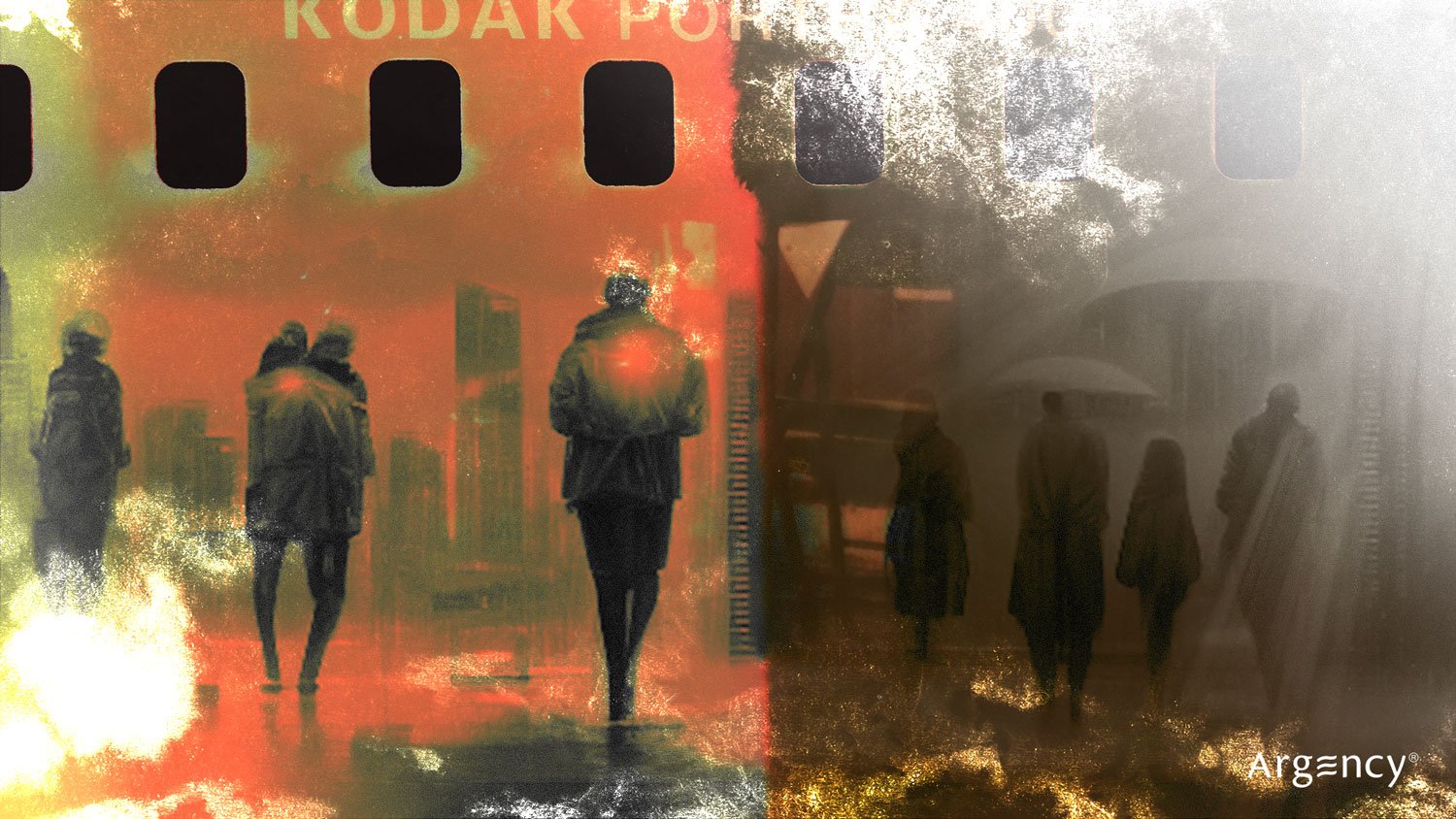
For creativity there will always be something left, it all depends on our degree of commitment. The question is not whether machines will take our place, it is whether we will comfortably hand it over to them.
Tomorrow is not «another story», it is our story. There will always be a tomorrow, because tomorrow depends on us. Whoever gives up believing it has already given up before even starting.