The fifth estate
Digital political communication is still “in nappies”. We debate it with Mario Riorda and Gabriel Conte.

Political communication is being transformed, once again, through digital media. We see how the dynamic of interaction changes, while it promotes new strategies and ways of relating to one another. We debate the change together with Mario Riorda and Gabriel Conte, first-rate interviewees.
The new Digital Political Communication is a phenomenon we will analyze with the contribution of two specialists, interviewed especially for the occasion: Mario Riorda, Consultant in Strategy and Political Communication for governments and parties in Latin America, and Gabriel Conte, Journalist and Editor-in-Chief of Mdz Online.

After the success of Barak Obama, many politicians want to venture into social media to boost their reach with the electorate. Is it possible to win over supporters? It is. The percentage of undecided voters will be more receptive to those candidates who bring them their projects and take an interest in them.
The Internet poses a new kind of communication: individual and collective, with proposals segmented according to the sector we interact with and the possibility of quantifying their responses. Various contributions can be added to the planning of a campaign. On this we consulted Mario Riorda:
What does the use of digital media bring to an election campaign?
Digital political communication brings different things, such as the possibility of expanding the spread of a message to a superlative degree and the possibility of generating loyalty-building actions that other media do not allow. In the Anglo-Saxon world it is the main way of fundraising, since it provides data both for learning the positive trends of our campaign and candidates and the negative ones. It provides constant information, beyond the need to sift through it systematically. It provides immediacy. It provides possibilities of interaction. It provides a rich database that is constantly updated. And most importantly, now and in the future: it provides the greatest imagined chances of microsegmentation for reaching each citizen or voter in a personalized way.
Is it a field that is still being discovered, or is it already included when setting out a campaign?
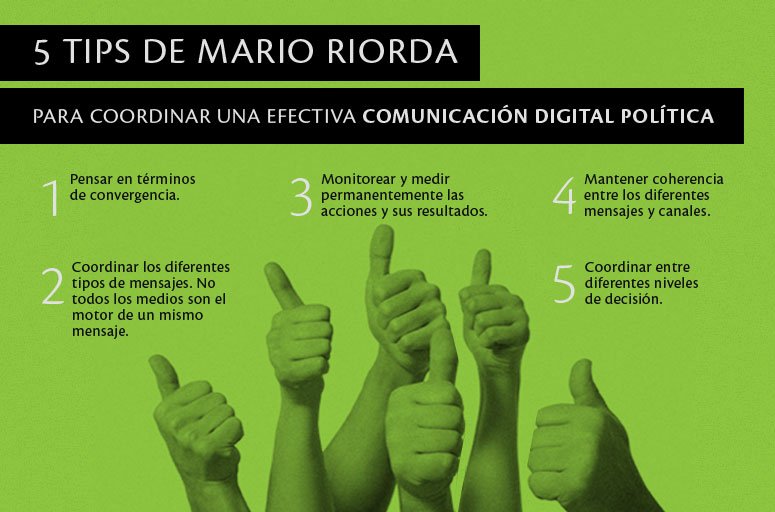
It is a field that is included in the design of campaigns, but that is being made day by day in the key of novelty. It is known to be a necessity, but it is still not thought of convergently. The digital media teams are brought in as an annex or attached to the teams once the strategies in conventional media have been designed. This changes day by day, but there is a long way to go.
Through social media, do you consider it possible to reverse voting intention or attract new supporters?
Surely yes, it is possible; but not if we understand them as an autonomous medium. Social media are one more medium and the chances are equivalent to the persuasive stimuli of the other media. Just as it is said that half the money invested in political advertising is money thrown away, because nobody knows its real effects, the same happens here. People act out of inertia or, more in this case, out of snobbery. Only if it is understood that communication is convergent, which means that there are migrating audiences and that I have to produce messages for every possible medium, then the chances will surely grow.

A presence on the Internet demands that communication not be based on a repetition of slogans, on party promotion and an accumulation of followers. You have to make the most of social media for what they are: a communication channel, and use them as tools to fight political disinterest and disengagement, involving the community, encouraging debate, listening and responding.
And what about here at home?
We consulted Gabriel Conte, journalist and editor, about the particular case of Mendoza and its political parties, in relation to the kind of work being done and some “recommendations” that, from his view as a journalist, he might propose:
In Mendoza, as parties, they are not working on the subject very seriously. Or at least, from journalism it does not show. They keep relying on email with closed-off opinion, instead of using technological and multimedia tools that could surprise the journalist, the outlet, and thus gain a place in public opinion. The Government, yes: you could say there was some building on the matter by the current party in order to win the elections, but that it was not sustained at party level. The experiences are few and isolated, although I know they have tried to make an effort. Their structures turn out to be as anachronistic as the leaders and activists who sustain them, which is why it is very hard to “force” them to use social media. Perhaps a few individuals will give it a go, and there are some in every party, but there is no collective strategy. Except for the case of La Cámpora, which has a level of development on the matter that lets them use the Internet –especially social media- in all its dimensions: text, images and sound.
As for the recommendations, it is very hard when they do not feel part of social media, but rather like foreign elements, forced to use them. You would have to create specific groups and guide them toward communicating their actions, ideas, proposals, etc. Because otherwise, they give in to the temptation of using social media only for election campaigns, or exclusively for one action and then they abandon them. I believe that 90% of those who were candidates in the last elections and opened a Facebook and a Twitter account never used it again afterwards.
As Gabriel Conte points out, most tend to abandon their profiles and throw away what they built, instead of carrying on working to keep winning supporters and to become a figure who is close and useful to their community. If they only show interest in citizens during campaigns, their intentions are easily called into question: “I only matter to them to win a vote”.
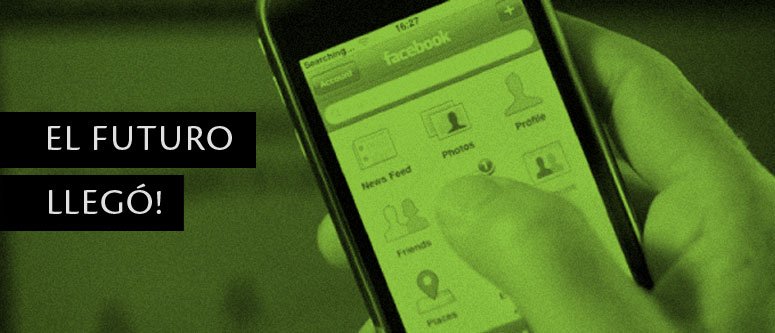
Even when the poverty rate in Latin America is high or the purchase of technology products remains reserved for a minority, electronic media have arrived in everyday life. Young people can already access the network daily through libraries, schools (Conectar Igualdad), internet cafés or wifi zones, among others, and practically all of them already have a personal account on social media, which shows us that facebook, twitter, blogs and other media are already an integral part of social reality.
It is possible that not everyone yet understands the power of the Internet as a medium and its reach, but currently there are more people connected to the Internet than tothe TV, and if we do the math, more than 50% of the electoral roll ofArgentinawill have been born after 1983 in middle-class households with access to digital media.
Given this, we thought it important to ask our interviewees how they think the politician-citizen relationship will change in the future, to which each one contributed a complementary view from their own position. For Mario Riorda “it probably will not change in the discussion relating to content, but it will in the forms; because among the effects it is generating a sense of immediacy or of a need to satisfy what in political science is called ‘perception of efficacy’, which is believing that my action contributes to determining a given policy or outcome. This means that citizens feel that their support, their criticism or their demands are perceived as useful. That is why both sectors, political and citizen, feel the need to be on the network”.
For his part, Gabriel Conte believes that “in time this is going to change. The Internet will serve as a platform for meeting and discussion. The experience of the FPV was interesting, gathering endorsements through social media, adding up support, messages. Although the idea is that everyone makes a great effort for just one person and, in the end, they turn out to be activists or friends of whoever runs the social media… One more lie of politics. Debate forums should be opened on ideas the parties already bring worked out. I am one of those who believe that parties should not hold a contest of ideas, but bring together people who already share the same core of basic agreements and, then, ask for help to spread those proposals or complement them”.
Digital political communication is still “in nappies”. The potential and the development we can imagine will, without doubt, change the politician-citizen relationship. Joining the new era by boosting direct contact and participation, as well as making the most of the Internet as a platform for spreading the word, are some of the challenges that parties, candidates and political institutions have to face in order to enrich their proposals and build a common project together with society.
Utopian? The Internet is a tool, not the solution. It will be up to all of us to encourage public debate, to interact, to propose and to organize ourselves in order to act, making the most of a new medium that will connect us beyond what we can imagine today.
We thank our interviewees for their collaboration:


Did you like the article? Share it! / Would you add something? Comment on it 🙂